

A weekly meal plan works best when every ingredient has a job. This UK family dinner plan gives you seven meals for four people, a combined shopping list and a cooking order that keeps the later meals based on frozen, tinned and dried ingredients.
It covers dinners only. It is not a full weekly food budget or a tailored nutrition plan. Portion needs differ between households, so adjust the quantities to suit the people eating.
The recipes below are original planning ideas and have not been kitchen-tested. The shopping quantities have been reconciled on paper. There is no claimed basket price: the example purchase sizes are planning assumptions, not verified products from a particular supermarket.
AI-generated content. Always verify ingredients and allergen information yourself.
The seven dinners#
| Day | Dinner | Why it sits here |
|---|---|---|
| 1 | Lemon chicken traybake | Use fresh chicken first, within its use-by date. |
| 2 | Lentil and tomato pasta | Carrots and lentils give the sauce substance. |
| 3 | Chickpea and spinach curry with rice | Uses tinned chickpeas and frozen spinach. |
| 4 | Lemon fish, potatoes and peas | Keep the fish frozen until its label says to defrost or cook it. |
| 5 | Jacket potatoes with smoky beans | Uses cooked tinned beans, tomatoes and a little cheese. |
| 6 | Vegetable and egg rice | Cook a fresh batch of rice for this dinner. |
| 7 | Lentil cottage pie | Uses more of the same vegetables and store-cupboard ingredients. |
One shopping list#
Check your fridge, freezer and cupboards before buying. Deduct what you can safely use; do not subtract something that has passed its use-by date. Ingredient weights below are before cooking. The bean quantities are drained weights; tomatoes include their juice. Check the actual drained weight on your tins.
| Ingredient | Example amount bought | Used in these dinners | Left from the purchase |
|---|---|---|---|
| Boneless chicken thighs | 1 × 800 g | 800 g | 0 g |
| Potatoes | 2 × 2500 g | 3800 g | 1200 g |
| Carrots | 1 × 1000 g | 1000 g | 0 g |
| Onions | 1 × 1000 g | 900 g | 100 g |
| Lemons | 2 × 1 each | 2 each | 0 each |
| Dried red lentils | 1 × 500 g | 400 g | 100 g |
| Dried pasta | 1 × 500 g | 300 g | 200 g |
| Tinned chopped tomatoes | 5 × 400 g | 2000 g | 0 g |
| Tinned cooked chickpeas | 2 × 400 g tins (240 g drained each) | 480 g drained | 0 g beans; 320 g liquid discarded |
| Tinned cooked kidney beans | 2 × 400 g tins (240 g drained each) | 480 g drained | 0 g beans; 320 g liquid discarded |
| Tinned coconut milk | 1 × 400 ml | 400 ml | 0 ml |
| Frozen spinach | 1 × 500 g | 300 g | 200 g |
| Frozen boneless white fish | 1 × 600 g | 600 g | 0 g |
| Frozen peas | 1 × 1000 g | 800 g | 200 g |
| Eggs | 1 × 12 each | 8 each | 4 each |
| Cheddar | 1 × 200 g | 200 g | 0 g |
| Dried rice | 1 × 1000 g | 600 g | 400 g |
For the chickpeas and kidney beans, the example assumes two 400 g tins yielding 240 g drained beans each. That is 480 g beans used, with about 320 g liquid drained away per pair of tins. If your tins yield a different amount, use enough to reach the recipe quantity; do not treat 400 g net weight as 400 g beans.
Potatoes can be bought loose if that better fits your shop. The two-bag example deliberately shows a remainder: buying a whole pack is different from using every gram that week. Keep unused raw ingredients according to their labels and condition; remaining food is not a guaranteed lunch or a cash saving already made. For a single shop, choose a cheddar pack whose after-opening directions cover day five to day seven, or one whose label permits freezing with suitable defrosting directions. If neither is available, change the plan rather than assume the opened cheese will keep.
Cupboard amounts used across the week: 120 ml cooking oil, 10 g garlic granules, 6 g smoked paprika, 4 g dried mixed herbs, 10 g mild curry powder and 4 g ground cumin. Salt and pepper are optional, to taste. Water is needed for boiling and adjusting sauces. These are not free ingredients; include any packs you need to buy when calculating your own bill.
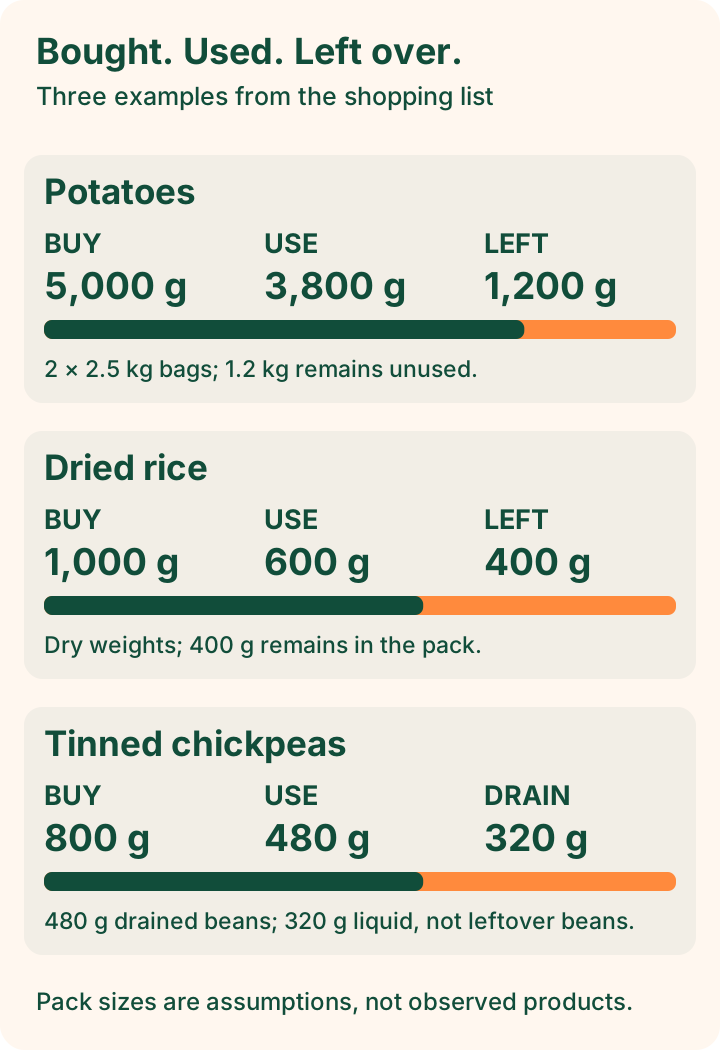
Three examples from the shopping list. Pack sizes are assumptions. The chickpea remainder is drained liquid, not leftover beans.
Day 1: lemon chicken traybake#
For four portions, use 800 g boneless chicken thighs, 800 g potatoes, 400 g carrots, one lemon, 30 ml oil, 2 g garlic granules and 3 g smoked paprika.
Heat the oven to 200°C, or 180°C fan. Cut the potatoes into small chunks and the carrots into thick batons. Toss the vegetables with half the oil and spread them across a large roasting tray. Roast for about 15 minutes, then add the chicken coated in the remaining oil, garlic, paprika and lemon juice. Keep the raw-chicken utensils away from ready-to-eat food.
Continue roasting until the vegetables are tender and the chicken is fully cooked; start checking after another 25 minutes, but allow more time if needed. A timer alone cannot establish doneness. The FSA's cooking guidance gives 70°C for two minutes, or 75°C for 30 seconds, at the centre as suitable temperature/time combinations. Check the thickest pieces with a clean food thermometer. Divide into four portions and serve.
Day 2: lentil and tomato pasta#
Use 200 g dried red lentils, 300 g dried pasta, 800 g chopped tomatoes, 200 g onion, 200 g carrot, 15 ml oil, 2 g garlic granules and 2 g dried herbs.
Cook the lentils separately according to their packet instructions until soft. Meanwhile, finely chop the onion and carrot. Soften them in the oil, add the garlic, herbs and tomatoes, and simmer until the carrot is tender. Stir in the cooked, drained lentils, adding a little water if the sauce becomes too thick. Cook the pasta according to its packet, drain and combine with the sauce.
A courgette can replace some carrot if that is what you already have, but weigh and record the swap in your own list. This plan does not assume that an extra vegetable is free or already included.
Day 3: chickpea and spinach curry#
Use 480 g drained cooked tinned chickpeas, 300 g frozen spinach, 400 ml coconut milk, 400 g chopped tomatoes, 200 g onion, 300 g dried rice, 15 ml oil, 2 g garlic granules and 10 g mild curry powder.
Soften the chopped onion in the oil. Stir in the garlic and curry powder briefly, then add the tomatoes, coconut milk and chickpeas. Simmer, stirring, until the sauce thickens slightly. Add the spinach and cook for the time specified on its packet, until thoroughly hot throughout. Cook the rice separately according to its packet and serve it straight away with the curry.
Use cooked tinned chickpeas here. Dried pulses need a different preparation method and are not an interchangeable quantity in this recipe.
Day 4: lemon fish, potatoes and peas#
Use 600 g boneless frozen white fish, 800 g potatoes, 400 g frozen peas, one lemon and 15 ml oil.
Cut the potatoes into chunks, toss with the oil and roast at 200°C, or 180°C fan, until tender, turning as needed. Prepare the fish according to its packaging: some products cook from frozen, while others require safe defrosting. Add lemon juice and cook for the packet's temperature and time, checking it is properly cooked. Cook the peas according to their packet and divide everything into four portions. Check fish for bones before serving.
Do not keep a pack of fresh fish in the fridge from the start of the week just because it appears on day four. The label's use-by and storage instructions take priority over this schedule.
Day 5: jacket potatoes with smoky beans#
Use four potatoes totalling about 1.2 kg, 480 g drained cooked tinned kidney beans, 400 g chopped tomatoes, 200 g onion, 100 g cheddar, 15 ml oil, 2 g garlic granules, 3 g smoked paprika and 4 g ground cumin.
Scrub and prick the potatoes. Bake at 200°C, or 180°C fan, until soft throughout; large potatoes can take an hour or longer. While they bake, soften the chopped onion in the oil. Add the garlic and spices, then the tomatoes and drained beans. Simmer until the onion is tender and the filling is piping hot. Split the potatoes, spoon over the filling and finish with the grated cheese.
Use cooked tinned kidney beans, not dry beans added straight to the sauce. Keep the remaining 100 g cheddar refrigerated as its pack directs. If its after-opening instructions do not cover day seven, freeze it in time only if that pack permits freezing, and follow its defrosting and use-by instructions. Otherwise, change the later meal and shopping list or buy a suitable pack nearer day seven; do not assume this one-shop example safely covers that cheese.
Day 6: vegetable and egg rice#
Use 300 g dried rice, eight eggs, 200 g frozen peas, 200 g carrots, 100 g onion and 15 ml oil.
Cook the rice fresh according to its packet. Finely chop the onion and carrot, then soften them in the oil in a large pan. Cook the peas according to the packet before adding them. Beat the eggs and cook them with the vegetables, stirring until fully set. Fold in the freshly cooked hot rice, heat everything thoroughly and serve immediately.
This is a soft vegetable-and-egg rice dish rather than a promise of restaurant-style fried rice. Do not save day three's refrigerated rice for this meal.
Day 7: lentil cottage pie#
Use 200 g dried red lentils, 1 kg potatoes, 200 g carrots, 200 g onion, 400 g chopped tomatoes, 200 g frozen peas, 100 g cheddar, 15 ml oil, 2 g garlic granules and 2 g dried herbs.
Cook the lentils according to their packet until soft. Boil the chopped potatoes until tender, drain and mash with a little reserved potato water. Soften the chopped onion and carrot in the oil; add the garlic, herbs and tomatoes and simmer until the vegetables are tender. Stir in the cooked lentils and peas, and continue cooking until the peas are cooked as directed on their packet and the filling is hot throughout.
Spoon into an ovenproof dish, top with the mash and grated cheese, and bake at 200°C, or 180°C fan, until browned and steaming hot in the centre. Divide into four portions. This method uses hot filling; a chilled or frozen assembled pie needs a different reheating schedule.
Keep the cooking schedule safe#
Shop with use-by dates and storage instructions in mind. Keep raw chicken sealed on the bottom shelf of the fridge and use it on day one, within its use-by date. Frozen fish, peas and spinach stay in the freezer until needed. Store eggs and cheese according to their labels. Keep unused tinned food covered in a suitable container in the fridge rather than in the opened tin.
If you cook extra portions, cool them promptly in smaller containers and refrigerate within two hours. The FSA's storage guidance advises eating suitable refrigerated leftovers within 48 hours or freezing them. Follow any shorter label instructions. Defrost in the fridge and use within 24 hours after fully defrosted; reheat only once until steaming hot throughout.
Rice is the exception to the general leftover window. Food Standards Scotland advises cooling cooked rice quickly, ideally within one hour, refrigerating it and using it within 24 hours. Reheat no more than once. For this plan, cooking rice fresh on days three and six avoids relying on stored rice.
Adapt the list to your supermarket and household#
Choose the shop that suits your location and how you actually buy food. Tesco, Sainsbury's, Asda, Aldi, Lidl, Morrisons, M&S, Ocado and Waitrose do not have identical ranges, pack sizes, offers or delivery coverage. Check the current store or delivery service before choosing a plan around it.
Use the retailer guide that answers your next shopping question. Each guide has its own example and assumptions; none is a live price comparison or a promise that a chain serves every UK address.
| Your next shopping question | Retailer guide | What to check before paying |
|---|---|---|
| Which Clubcard Price applies to my list? | Tesco meal planning | Ordinary, member and personal prices for the exact packs. |
| Do Nectar offers change my basket total? | Sainsbury's meal planning | The offer shown to you, eligibility and full pack cost. |
| Which pack sizes keep my checkout spend useful? | Asda budget meal planning | Whole packs bought against the amounts used. |
| What can I make from this week's vegetables? | Aldi Super 6 planning | Current selection, availability and the rest of the list. |
| How do I plan around Lidl Plus offers? | Lidl meal planning | Current terms, activated offers and non-offer packs. |
| Can one shop support freezer dinners? | Morrisons batch cooking | Batch portions, freezer space and safe storage. |
| How do two people use opened packs? | Waitrose meals for two | Pack reuse, leftovers and the actual local range. |
| What does an online weekly shop cost in total? | Ocado delivered-shop planning | Bought packs, delivery slot and any pass terms. |
| Does a dinner offer fit this occasion? | M&S Food dinner planning | Included portions, offer terms and alternatives. |
Begin with the quantities needed, then compare the packs available. A larger pack can cost less per kilogram while still costing more at the till. Keep member prices and personal coupons separate from ordinary prices, and add delivery charges where they apply. This guide makes no claim that one retailer is cheapest.
For two people, halve the recipe quantities and recalculate the shopping list. For a larger household, multiply quantities, use adequate pan and tray space, and check doneness; cooking time does not scale in a neat straight line. If appetites are larger, add the extra ingredients to the list rather than counting unplanned sides as part of the original shop.
The plan includes wheat in conventional pasta, eggs, fish and milk in cheddar. Check every product label, including spice mixes, for allergens and cross-contamination information. A substitution does not automatically make a meal suitable for an allergy.
Start with the dinner table and list above, cross off what you can safely use at home, and adjust the packs to your actual shop. That gives you a plan you can inspect before paying, without needing an account or an app.
How this guide was prepared#
This is a planning guide by Alexander Eriksson, founder of Smaklig. The recipes have not been kitchen-tested. The quantities were checked against one ingredient ledger, and the food-safety sources were checked on 21 September 2026. That is a fact-check date, not a publication date.
Read our method for how we handle assumed pack sizes, official sources, AI-assisted content and corrections. You can also return to the shopping list or browse the available guides.
Questions about this plan
Does this meal plan include breakfast and lunch?
No. It plans seven dinners for four people. Breakfasts, lunches, snacks and drinks need their own list. The recipes are divided into four portions, so do not also count those same portions as guaranteed lunches.
Can I buy everything at one supermarket?
The plan uses ordinary ingredients, but stock, pack sizes and delivery coverage vary. Check your chosen shop before you go. Compare your actual packs with the quantities needed, and substitute by cooking role rather than assuming every supermarket stocks an identical product.
Should I cook the whole week on Sunday?
This plan is designed for cooking across the week, not keeping seven days of cooked food in the fridge. Keep later frozen ingredients frozen until needed. If you batch-cook a suitable dish, cool and freeze it promptly and label it, following food-safety and packaging instructions. Cook the rice fresh for each rice dinner.
How do I adapt the plan for two people?
Halve each recipe's ingredient amounts to make two portions, then recalculate the packs you need to buy. Half the recipe does not necessarily mean half the checkout bill. Keep a separate note of unopened or safely stored ingredients left from whole packs.
Sources and further reading
- How to chill, freeze and defrost food safely — Food Standards Agency
- Food storage — Food Standards Scotland
- Cooking your food — Food Standards Agency
- Cooking food safely — Food Standards Scotland