

A Tesco meal plan starts with dinners and quantities, then checks which Clubcard Prices actually apply. This guide gives you three family dinners and a shopping worksheet that keeps ordinary prices, general member prices and personal offers separate. There is no assumed discount or invented basket total.
These are original planning ideas, not kitchen-tested recipes. The example makes three dinners for four people: 12 dinner portions, not a whole week’s food or a set of extra lunches. Pack sizes are assumptions, not verified products or prices at this retailer. Adjust appetites and check the actual packs before shopping.
AI-generated content. Always verify ingredients and allergen information yourself.
Keep three price columns#
Write your list before opening the offers. Then copy the applicable price into the right column, along with the pack size and offer end date. Leave a cell blank when you have not checked it; a blank is more useful than a guessed saving.
| Item needed | Ordinary pack price | General Clubcard Price | Your personal price | Which price applies? |
|---|---|---|---|---|
| Pasta: 300 g dry | Enter current pack price | Enter only if eligible | Enter only if shown to you | Exact pack and shopping date |
| Cheddar: 100 g | Enter current pack price | Check the offer label | Check your own offer | Compare the full pack you must buy |
| Kidney beans: 480 g drained | Check tin size and yield | Check qualifying product | Check your own offer | Count drained beans, not tin weight |
Tesco distinguishes general and personal offers. The Your Clubcard Prices terms require selected invited customers to unlock their offers before shopping. Those terms cover larger Tesco stores and tesco.com home shopping, with Express, Whoosh, Marketplace and One Stop excluded. Check the actual current offer before relying on it.
Personal offers apply to their specified product and pack. If your chosen pasta is unavailable, a different pasta can still work for dinner, but it does not inherit that personal discount. Look up its own price. The plan adapts; the retailer’s offer conditions do not.
Decide by the whole shop#
A cheaper price per kilogram can help compare similar products, but it does not tell you whether you need the larger pack. The CMA’s unit-pricing guide explains comparing equivalent units. Keep that comparison alongside the amount you actually pay and the quantity you can use.
Suppose the meal needs 100 g cheese and you are considering 200 g and 400 g packs. The smaller pack leaves 100 g; the larger leaves 300 g. Write the real two pack prices beside those amounts. Choose the larger one only if the extra spend and storage make sense for you. Neither option is declared cheaper here because no prices were observed.
The worked dinners deliberately reuse onions and tomatoes. That makes a useful list before any discount is applied. If an offer would add food with no planned meal, put it aside until you have checked the whole basket.
One shopping list#
The amounts below cover all three dinners. Weigh pasta, rice and lentils dry; tinned pulses are weighed drained. Vegetable weights are before cooking, with trimming or peeling losses not measured. Buy a little more where your preparation needs it, and record that adjustment. Water and optional salt or pepper are not fixed quantities.
Oil and seasonings are included as example full purchases. Cross them off only if you already have enough suitable ingredients; cupboard food is not automatically free. The remainder column is food left from a purchase, not an additional meal already made.
| Ingredient | Assumed amount bought | Used in this plan | Remaining ingredient |
|---|---|---|---|
| Dried pasta | 1 × 500 g | 300 g | 200 g |
| Cooked tinned chickpeas | 1 tin(s): 400 g total net, 240 g drained | 240 g | 0 g edible; 160 g liquid drained away |
| Tinned chopped tomatoes with juice | 2 × 400 g | 800 g | 0 g |
| Frozen spinach | 1 × 500 g | 200 g | 300 g |
| Onions | 1 × 500 g | 450 g | 50 g |
| Potatoes | 1 × 1000 g | 800 g | 200 g |
| Eggs | 1 × 6 each | 6 each | 0 each |
| Frozen peas | 1 × 500 g | 200 g | 300 g |
| Cheddar | 1 × 200 g | 100 g | 100 g |
| Cooked tinned kidney beans | 2 tin(s): 800 g total net, 480 g drained | 480 g | 0 g edible; 320 g liquid drained away |
| Carrots | 1 × 500 g | 200 g | 300 g |
| Wraps | 1 × 8 each | 8 each | 0 each |
| Cooking oil | 1 × 500 ml | 45 ml | 455 ml |
| Dried mixed herbs | 1 × 15 g | 2 g | 13 g |
| Smoked paprika | 1 × 40 g | 4 g | 36 g |
| Ground cumin | 1 × 40 g | 2 g | 38 g |
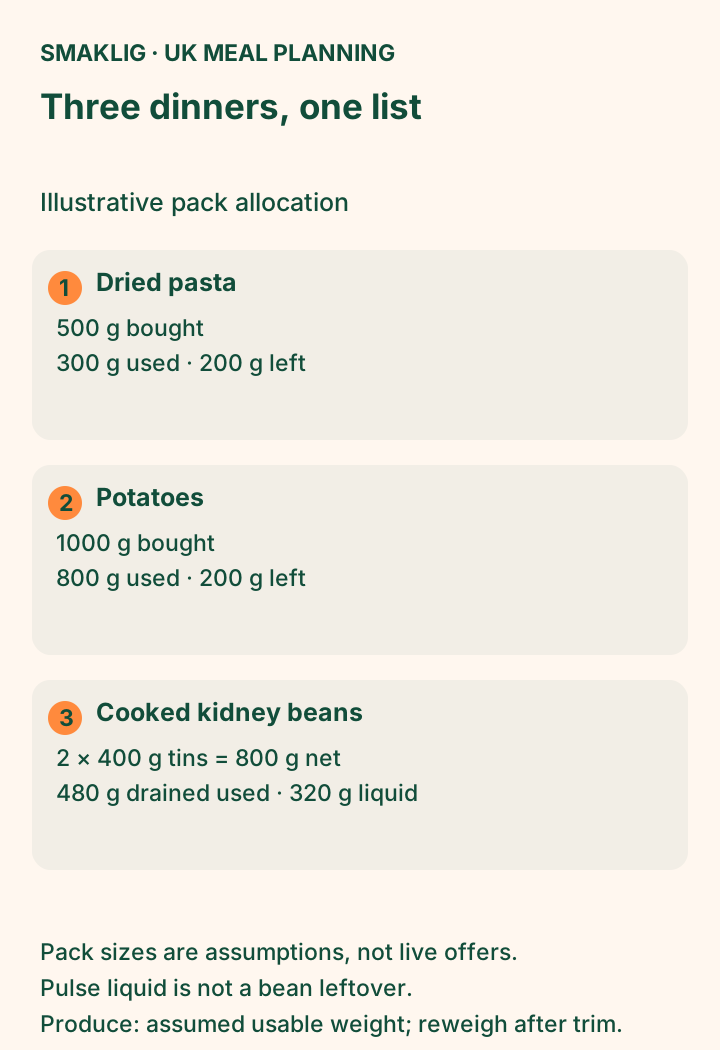
Planning quantities, not a priced retailer basket. The diagram summarises the list; it is not evidence of a tested recipe or a saving.
Three dinners from the list#
Chickpea, tomato and spinach pasta#
For 4 portions: 300 g dried pasta, 240 g cooked tinned chickpeas, 400 g tinned chopped tomatoes with juice, 200 g frozen spinach, 150 g onions, 15 ml cooking oil, 2 g dried mixed herbs.
Soften the chopped onion in the oil. Add the tomatoes and herbs, then simmer until the onion is tender. Stir in the drained chickpeas and spinach; follow the spinach packet’s cooking instructions and make the sauce hot throughout. Cook the pasta separately according to its packet, drain and combine. Add a little water if the sauce is too thick.
Potato and pea frittata#
For 4 portions: 800 g potatoes, 6 each eggs, 200 g frozen peas, 150 g onions, 100 g cheddar, 15 ml cooking oil.
Cut the potatoes into small pieces and boil until tender; drain well. Cook the peas as directed. Soften the chopped onion in the oil in an ovenproof frying pan. Add potatoes and peas, then pour over the beaten eggs and scatter over the cheese. Cook gently until the edges set, then finish in an oven at 180°C fan until the centre is fully set and hot. Use an ovenproof dish if your pan is unsuitable. Do not rely on browning at the edges to judge the middle.
Smoky bean and carrot wraps#
For 4 portions: 480 g cooked tinned kidney beans, 400 g tinned chopped tomatoes with juice, 150 g onions, 200 g carrots, 8 each wraps, 15 ml cooking oil, 4 g smoked paprika, 2 g ground cumin.
Grate the carrot and chop the onion. Soften both in the oil, stir in the spices, then add the tomatoes and drained cooked beans. Simmer until the carrot is tender and the filling is thoroughly hot. Warm the wraps following their packet and divide the filling between eight wraps, two per portion. These quantities use cooked tinned kidney beans, not dried beans.
Cook in a sensible order#
Make these dinners on three consecutive evenings, checking the use-by and after-opening instructions for eggs, cheese and wraps. Only open tins when needed. Keep frozen vegetables frozen until you cook their measured portions. Store the remaining cheese promptly as its label directs; this example does not promise it will last until an unspecified future meal.
If you save cooked portions, follow FSA cooling and storage guidance: refrigerate promptly, within two hours, then use suitable leftovers within 48 hours or freeze. Follow a shorter label limit where given. Defrost in the fridge and use within 24 hours of full defrosting; reheat once until steaming hot. The remaining dry pasta and raw potatoes in the table are different from cooked leftovers.
Conventional pasta and wraps can contain wheat; the frittata contains eggs and milk in the cheese. Read every label, including seasonings and any replacement product. These examples are not personalised for allergies.
Before you shop#
Check dates, labels, quantities and your actual household’s needs. Tick off what is safely available at home, then enter the packs you need to buy. A substitution changes the ingredient list, the method and sometimes the allergens; it does not preserve an old price or make a meal allergy-safe.
If you are comparing a Tesco shop with an online delivery, use the Ocado delivered-shop guide to add the delivery slot and any pass cost to the packs you would buy. Compare your actual payable totals; neither guide establishes which retailer is cheaper.
For a longer plan, use our seven-dinner UK family meal plan. Read our method for assumptions and corrections, or browse the available guides.
This guide is by Alexander Eriksson, founder of Smaklig. Retailer and food-safety sources were checked on 21 September 2026; that is a source-check date, not a claimed publication or kitchen-test date.
Questions about this plan
Are Clubcard Prices the same as Your Clubcard Prices?
No. Clubcard Prices are general member offers; Your Clubcard Prices are personalised offers for selected invited customers. Check the exact item, pack size, channel and validity period. A price visible to someone else is not proof that it applies to your shop.
Can I use a personal price at Tesco Express?
The Your Clubcard Prices terms checked for this guide exclude Express, Whoosh, Marketplace and One Stop. They describe larger Tesco stores and tesco.com home shopping. This statement concerns the personal programme; check the separate terms for any general Clubcard Price.
What if the offer item is unavailable?
Choose a replacement that works in the meal, then check its own price and pack size. Your Clubcard Prices terms do not transfer a personal offer to substitutions. Recalculate the checkout spend and any remainder instead of leaving the original discount in your worksheet.
Should I buy an extra item because it has a member price?
Only if it has a useful place in your plan and fits your budget. A discount against a reference price does not mean the extra purchase lowers what you pay today. Check how much you need, what you already have and whether you can store the remainder.
Sources and further reading
- Clubcard Prices and Your Clubcard Prices — Tesco
- Clubcard terms and conditions — Tesco
- A short guide to unit pricing — Competition and Markets Authority
- How to chill, freeze and defrost food safely — Food Standards Agency