

A Sainsbury's meal plan is a list of dinners and quantities built around what your household will use. Nectar offers can then change which eligible pack you choose. This example makes three dinners for four people and assigns the whole pepper and cheddar purchases before any offer enters the decision.
It covers 12 dinner portions, not breakfasts, lunches or a complete weekly budget. These original cooking ideas have not been kitchen-tested. Packs are planning assumptions, not a checked Sainsbury's basket; no price or saving is claimed. Adapt portion sizes to your household.
AI-generated content. Always verify ingredients and allergen information yourself.
Build your Sainsbury's meal plan before checking Nectar#
Start with the meals below, then check the combined shopping list. Choosing a larger pack first creates a different problem: finding somewhere to put it. Here, 600 g peppers is split between couscous and pasta, while 200 g cheddar is divided between the frittata and pasta. Those are two complete allocations, not two vaguely promised uses for leftovers.
| Dinner | Four portions of | Pack-sharing job |
|---|---|---|
| 1 | Smoky chickpea and pepper couscous | Use half the peppers. |
| 2 | Pea and cheddar frittata with potatoes | Use half the cheddar. |
| 3 | Pepper and tomato pasta | Finish the allocated peppers and cheddar. |
Choose three cooking evenings that fit the dates and storage instructions on your actual food. Dinner numbers are an order, not permission to keep an opened product longer than its label allows. If your plans change, move the pepper pasta earlier or freeze a suitable ingredient according to its instructions.
Ordinary prices, Nectar Prices and personal offers#
Keep three separate entries when checking a pack: the ordinary price available to you, a qualifying general Nectar Price, and any personal offer actually present in your account. Do not assume those discounts stack, or that another shopper has your offer. Confirm the applicable price and conditions before paying.
Sainsbury's Nectar Prices help describes general Nectar Prices on selected products in supermarkets and online, with Sainsbury's Local excluded. Its separate Your Nectar Prices help says unlocked personal offers can be used through eligible supermarket checkouts or online with a linked Nectar account; in Sainsbury's Local, they require SmartShop and a scanned Nectar card. Do not apply a general supermarket or online price to Local. Both help pages were checked on 26 September 2026; check your actual offer, product, date and channel before paying.
| What you see | What to record | Meal-plan decision |
|---|---|---|
| Ordinary shelf or online price | Exact pack, quantity and checkout price | Keep it as the available non-offer comparison. |
| General Nectar Price | Eligible product, dates, channel and membership requirements | Use it only if the pack fits the list. |
| Your Nectar Prices offer | The offer in your own account and its redemption conditions | Check your eligible price; do not copy somebody else's saving. |
| A promotion requiring extra units | Full quantity bought and total payment | Allocate every extra unit before accepting it. |
No personal offer has been observed for this example. A pepper offer is not assumed to exist. If only a larger cheddar pack qualifies, the extra cheese needs a real meal or safe storage plan; it is not a saving merely because the unit price is lower. The CMA's unit-pricing guide explains how a common unit helps compare different sizes. You still need the checkout amount and the quantity you can use.
One list with each pack assigned#
All recipe amounts are raw, dry or frozen as specified. Fresh-vegetable pack weights are nominal before preparation; trim loss has not been measured. Weigh the usable peppers and onions after removing inedible parts. If the pack falls short, buy enough extra or reduce the recipes proportionately and recalculate your list. The arithmetic below assumes the stated usable amounts are available.
| Ingredient | Example purchase | Used across three dinners | Ingredient remainder |
|---|---|---|---|
| Cooked tinned chickpeas | 2 × 400 g tins (240 g drained each) | 480 g drained | 0 g beans; 320 g liquid discarded |
| Dried couscous | 1 × 500 g | 300 g | 200 g |
| Peppers | 1 × 600 g | 600 g | 0 g |
| Onions | 1 × 1000 g | 450 g | 550 g |
| Cooking oil | 1 × 500 ml | 50 ml | 450 ml |
| Garlic granules | 1 × 40 g | 4 g | 36 g |
| Smoked paprika | 1 × 40 g | 4 g | 36 g |
| Eggs | 1 × 12 each | 8 each | 4 each |
| Cheddar | 1 × 200 g | 200 g | 0 g |
| Frozen peas | 1 × 500 g | 300 g | 200 g |
| Potatoes | 1 × 1000 g | 800 g | 200 g |
| Dried mixed herbs | 1 × 15 g | 4 g | 11 g |
| Dried pasta | 1 × 500 g | 300 g | 200 g |
| Tinned chopped tomatoes | 1 × 400 g | 400 g | 0 g |
The chickpea row buys 800 g net contents and assumes 480 g drained beans. The other 320 g is discarded liquid, not another meal's chickpeas. Check your tins' drained weights before buying. Oil and seasonings are included as example purchases even if you already own them: check your cupboard and remove only the packs you do not need. Water and optional salt and pepper are variable, uncosted extras.
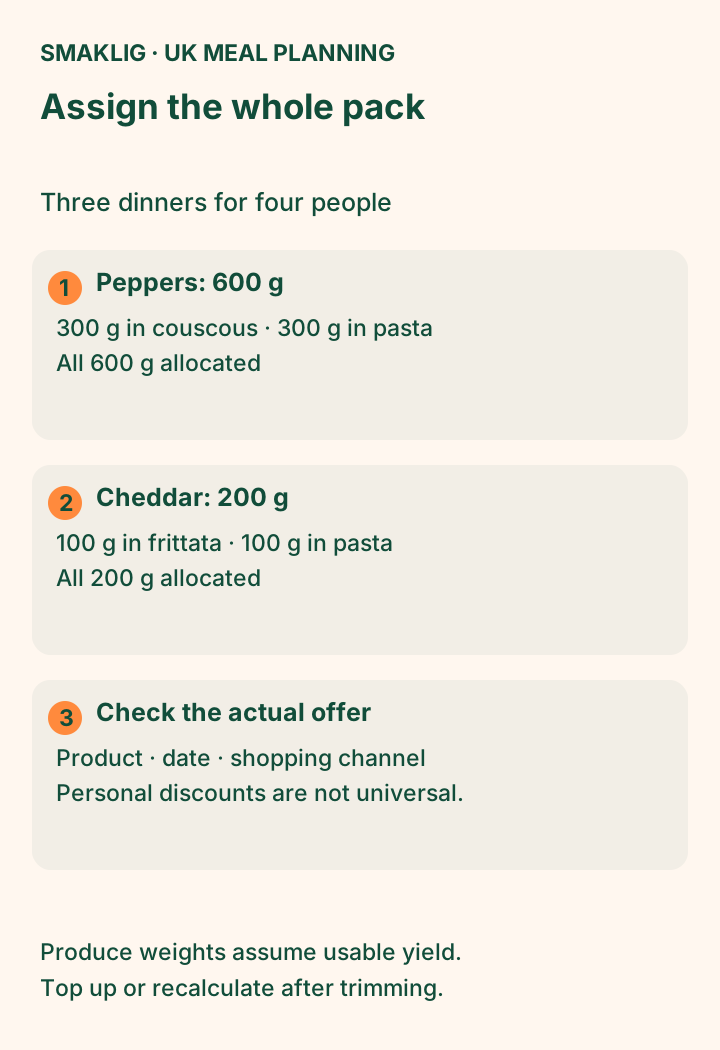
The allocation shows intended ingredient use, not an observed purchase or a priced offer.
Dinner 1: smoky chickpea and pepper couscous#
For four portions, use 480 g drained cooked chickpeas, 300 g dried couscous, 300 g prepared peppers, 150 g prepared onion, 15 ml oil, 2 g garlic granules and 4 g smoked paprika.
Heat the oven to 200°C, or 180°C fan. Cut the peppers and onion into small pieces, coat with the oil, garlic and paprika, and spread across a roasting tray. Roast until softened, turning as needed; start checking after about 20 minutes. Add the drained chickpeas and continue until everything is thoroughly hot. Oven timing is a guide, not a tested result.
Prepare the couscous with water according to its packet, fluff with a fork and fold through the vegetables and chickpeas. Divide into four portions. If replacing couscous, use the replacement's own cooking method and recalculate its dry quantity; a substitution does not inherit an offer on the original product.
Dinner 2: pea and cheddar frittata with potatoes#
For four portions, use 8 eggs, 100 g cheddar, 300 g frozen peas, 150 g prepared onion, 800 g potatoes, 20 ml oil and 2 g dried mixed herbs.
Scrub the potatoes, cut into small chunks and coat with 10 ml oil. Roast at 200°C, or 180°C fan, until soft inside. Meanwhile, soften the chopped onion in the remaining 10 ml oil. Cook the peas according to their packet and drain. Beat the eggs, stir in the herbs and grated cheese, then add the onion and peas.
Pour into a suitably sized ovenproof dish and bake until the centre is set and the egg is thoroughly cooked. Start checking after about 20 minutes, allowing longer for a deep dish. Serve with the potatoes, dividing both into four portions. Check doneness using the FSA's cooking guidance, rather than relying solely on the timer.
Dinner 3: pepper and tomato pasta#
For four portions, use 300 g dried pasta, 400 g chopped tomatoes including juice, 300 g prepared peppers, 150 g prepared onion, 100 g cheddar, 15 ml oil, 2 g garlic granules and 2 g dried mixed herbs.
Finely chop the onion and peppers. Soften them in the oil, stirring regularly, then add the garlic, herbs and tomatoes. Simmer until the vegetables are tender, adding a little water if needed to prevent sticking. Cook the pasta according to its packet. Drain, combine with the sauce and divide between four bowls. Grate the cheddar over the portions.
This uses the second half of the planned cheese and peppers. It does not also leave four lunches: all of the recipe is allocated to four dinners. Make a separately calculated larger batch if you need lunches.
Deal with remainders before another shop#
The onions, potatoes, eggs, peas and dried goods left in the table are unused ingredients. They are not cooked leftovers and do not all have the same storage life. Keep frozen peas frozen, dried foods sealed and fresh products according to their labels. Write the actual remaining amounts on your next list before adding another bag.
For any cooked food you do not eat, follow the FSA's chilling and freezing guidance: cool and refrigerate within two hours, use refrigerated leftovers within 48 hours or freeze them promptly. Follow any stricter food or packaging instructions. Reheat only once until steaming hot throughout.
Before paying, check that the peppers and cheddar still cover both intended meals, each Nectar offer applies to your actual channel and pack, and no extra purchase has slipped in solely for a discount. For a longer plan, use the seven-dinner family shopping list. Our editorial method explains the evidence limits, and the author page identifies the byline.
Questions about this plan
Are Nectar Prices available in Sainsbury's Local?
General Nectar Prices exclude Sainsbury's Local. Personal Your Nectar Prices are different: Sainsbury's says an unlocked eligible offer can be used in Local with SmartShop and a scanned Nectar card. Check your own offer, exact product and current conditions; do not transfer a supermarket or online price to Local.
Are personalised offers the same for everyone?
No. Treat Your Nectar Prices as offers in your own account, not a universal price. This guide has not observed an individual account offer and does not price its shopping list using one.
How do I use Nectar offers online?
Check that your Nectar account is linked and that the exact item qualifies under the current online terms. Your Nectar Prices is not limited to SmartShop: Sainsbury's describes eligible supermarket checkouts and online use. Confirm the price before paying.
Can a larger pack still be a worse purchase?
Yes. A lower unit price can still mean a larger payment or food you cannot use. Allocate the extra quantity to a real meal or suitable storage plan, then compare the total amount you will pay.
Sources and further reading
- Nectar Prices — Sainsbury's
- Your Nectar Prices — Sainsbury's
- A short guide to unit pricing — Competition and Markets Authority
- How to chill, freeze and defrost food safely — Food Standards Agency
- Cooking your food — Food Standards Agency