

An Aldi meal plan works better when vegetables have a cooking role, rather than a fixed place on an offer list. These three dinners use a roasting tray, a pasta pan and a lentil pot. The shopping list shows exactly where the ingredients go, so you can adapt it to the Super 6 selection you actually find.
These are original planning ideas, not kitchen-tested recipes. The example makes three dinners for four people: 12 dinner portions, not a whole week’s food or a set of extra lunches. Pack sizes are assumptions, not verified products or prices at this retailer. Adjust appetites and check the actual packs before shopping.
AI-generated content. Always verify ingredients and allergen information yourself.
Choose a cooking role before an offer#
Aldi’s Super 6 page says you do not need a membership or digital coupon. It does not make this week’s list a reliable shopping list for next week. The page’s descriptions of how often the selection changes are inconsistent, so this guide gives no fixed refresh timetable.
First choose a dinner, then see whether an available vegetable fits it. An offer is optional. If the useful quantity is smaller than a promotional pack and the remainder has no destination, a loose or smaller alternative may suit you better. Compare the actual full price as well as the unit price. No current Super 6 price or cheapest-shop claim is used here.
| Cooking role | Example in this plan | Possible alternative | Change to the method |
|---|---|---|---|
| Firm roasting vegetable | Carrot with potatoes | Parsnip or squash | Cut evenly; check tenderness; allow for peel and seeds |
| Tender vegetable for pasta | Broccoli | Courgette | Cook sliced courgette in the pan rather than treating it like a firm broccoli stalk |
| Sweet base in a lentil pot | Finely chopped carrot | A mix of carrot and pepper | Add pepper later if you want it to keep its shape |
| Quick green addition | Frozen peas | Frozen green beans | Use the new packet’s cooking instructions; cut if needed |
These are cooking suggestions, not claims about today’s six offers. Start with the recipe’s vegetable weight as a planning guide, then adjust for edible yield and appetite. The water released by courgette, the seeds in squash and the tough end of a stalk are not interchangeable quantities. Once you swap, revise the list; do not keep the original remainder total and call it exact.
Give the rest of each pack a job#
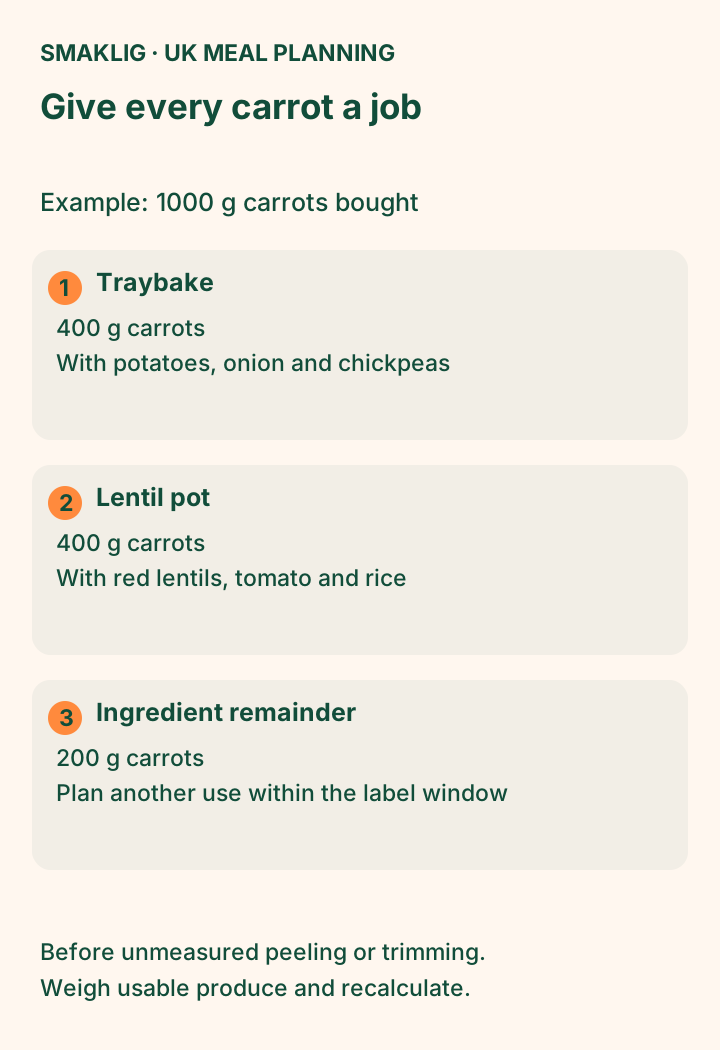
The baseline uses 400 g carrots in the traybake and another 400 g in the lentil dinner. A 1 kg purchase therefore has 200 g left before unmeasured trimming. That remainder could go into a later soup, but the soup is not included as a fourth dinner or a free meal.
The same principle applies to broccoli. If the pack available is larger than the example, use suitable extra florets and tender stalk in the pasta or record them for another meal. If you increase the pasta dinner, adjust the other ingredients and portions too. A large vegetable pack does not turn four planned portions into six by itself.
One shopping list#
The amounts below cover all three dinners. Weigh pasta, rice and lentils dry; tinned pulses are weighed drained. Vegetable weights are before cooking, with trimming or peeling losses not measured. Buy a little more where your preparation needs it, and record that adjustment. Water and optional salt or pepper are not fixed quantities.
Oil and seasonings are included as example full purchases. Cross them off only if you already have enough suitable ingredients; cupboard food is not automatically free. The remainder column is food left from a purchase, not an additional meal already made.
| Ingredient | Assumed amount bought | Used in this plan | Remaining ingredient |
|---|---|---|---|
| Potatoes | 1 × 1000 g | 800 g | 200 g |
| Carrots | 1 × 1000 g | 800 g | 200 g |
| Cooked tinned chickpeas | 2 tin(s): 800 g total net, 480 g drained | 480 g | 0 g edible; 320 g liquid drained away |
| Onions | 1 × 500 g | 500 g | 0 g |
| Dried pasta | 1 × 500 g | 300 g | 200 g |
| Broccoli | 1 × 500 g | 400 g | 100 g |
| Frozen peas | 1 × 500 g | 300 g | 200 g |
| Cheddar | 1 × 200 g | 100 g | 100 g |
| Dried red lentils | 1 × 500 g | 200 g | 300 g |
| Tinned chopped tomatoes with juice | 1 × 400 g | 400 g | 0 g |
| Dried rice | 1 × 500 g | 300 g | 200 g |
| Cooking oil | 1 × 500 ml | 50 ml | 450 ml |
| Smoked paprika | 1 × 40 g | 4 g | 36 g |
| Mild curry powder | 1 × 80 g | 4 g | 76 g |
Planning quantities, not a priced retailer basket. The diagram summarises the list; it is not evidence of a tested recipe or a saving.
Three dinners from the list#
Root vegetable and chickpea traybake#
For 4 portions: 800 g potatoes, 400 g carrots, 480 g cooked tinned chickpeas, 200 g onions, 20 ml cooking oil, 4 g smoked paprika.
Heat the oven to 200°C or 180°C fan. Cut the potatoes and carrots into small even pieces and the onions into wedges. Toss with the oil and paprika, spread across trays without crowding, and roast until the roots are becoming tender, turning as needed. Add the drained cooked chickpeas for the final part of cooking, stirring them through so everything becomes thoroughly hot. Check the largest potato pieces are soft before serving. Roast time depends on cut size and tray space; start checking the vegetables after about 30 minutes.
Broccoli and pea pasta#
For 4 portions: 300 g dried pasta, 400 g broccoli, 300 g frozen peas, 100 g onions, 100 g cheddar, 15 ml cooking oil.
Chop the broccoli, including the tender part of the stalk. Soften the chopped onion in the oil. Cook the pasta according to its packet, adding the broccoli to boiling water long enough to become tender. Cook the frozen peas as their packet directs. Drain, reserving a little pasta water, and toss with the onion, peas and grated cheese. Add reserved water a spoonful at a time to loosen the mixture; no separate cream or sauce jar is assumed in the list.
Carrot and lentil pot with fresh rice#
For 4 portions: 200 g dried red lentils, 400 g tinned chopped tomatoes with juice, 400 g carrots, 200 g onions, 300 g dried rice, 15 ml cooking oil, 4 g mild curry powder.
Soften the chopped onion and finely diced carrot in the oil, then briefly stir in the curry powder. Add the tomatoes and lentils with the amount of water directed on the lentil packet. Simmer, stirring and adding water as needed, until the lentils and carrots are soft; follow the packet’s cooking instructions. Cook the rice fresh in a separate pan as directed and serve immediately. This is a mild lentil pot, not a promise of a particular restaurant-style curry.
Keep the food safe and the plan flexible#
Plan the three dinners across three evenings and check that the fresh vegetables and opened cheese remain suitable for that schedule. Keep frozen peas frozen until required. Do not buy a short-dated ingredient for a later meal unless you have an appropriate, labelled storage or freezing plan.
For ordinary suitable leftovers, the FSA advises prompt cooling and refrigeration, generally within two hours, then eating within 48 hours or freezing. Follow shorter packaging instructions. Thaw in the fridge, use within 24 hours after fully defrosted and reheat only once until steaming hot.
Cook the rice for the lentil dinner fresh. If you do keep rice, Food Standards Scotland advises faster cooling, ideally within an hour, and no more than 24 hours refrigerated before use. It is not covered by the ordinary 48-hour window. Do not leave a pan at room temperature while deciding what to do with it.
Conventional pasta contains wheat and cheddar contains milk; curry mixes can have other allergens. Read all labels and the replacement ingredient’s instructions. Removing one ingredient is not proof of an allergy-safe dish.
Before you shop#
Check dates, labels, quantities and your actual household’s needs. Tick off what is safely available at home, then enter the packs you need to buy. A substitution changes the ingredient list, the method and sometimes the allergens; it does not preserve an old price or make a meal allergy-safe.
For a longer plan, use our seven-dinner UK family meal plan. Read our method for assumptions and corrections, or browse the available guides.
This guide is by Alexander Eriksson, founder of Smaklig. Retailer and food-safety sources were checked on 21 September 2026; that is a source-check date, not a claimed publication or kitchen-test date.
Questions about this plan
Does Aldi Super 6 require a loyalty card?
The Super 6 page checked for this guide says no membership or digital coupon is needed. Check the current range and price in the shop you use; this guide does not assume a particular vegetable is on offer today.
Can I change the vegetables in this meal plan?
Yes, but change them by cooking role. A firm root vegetable needs a different start from a tender courgette or frozen peas. Recalculate the amount you buy, allow for trimming and follow the appropriate cooking instructions. The original list only balances for the stated ingredients.
Are Super 6 offers identical in every Aldi store?
Do not assume that. Aldi’s current page notes variation in ranges and prices between stores and formats. Check your chosen branch. A UK-focused guide is not proof that the same offer or stock is available throughout all four nations.
How often does Super 6 change?
Check Aldi’s live page and your store instead of relying on a fixed reset day from this guide. The page reviewed contained inconsistent wording about frequency. Choose meals that still work if the vegetable or price changes before your shop.
Sources and further reading
- Super 6 — Aldi UK
- A short guide to unit pricing — Competition and Markets Authority
- How to chill, freeze and defrost food safely — Food Standards Agency
- Food storage — Food Standards Scotland