

An Ocado meal plan needs two calculations: the food your household will use and the cost of getting that food delivered. Compare individual slots with a delivery pass over the same period, using only the orders and benefits you can actually use. A pass is not automatically cheaper because its cost can be divided across hypothetical weekly shops.
Below is a three-dinner example for two, followed by a worksheet for your own complete order. It is not a seven-day meal plan or full weekly food budget: add other dinners, breakfasts, lunches, snacks, drinks and household items separately. The original recipes have not been kitchen-tested. All purchase sizes are assumptions, not verified Ocado products or prices.
AI-generated content. Always verify ingredients and allergen information yourself.
Start the Ocado meal plan with three actual dinners#
| Dinner | What to cook | What to check when the order arrives |
|---|---|---|
| 1 | Turkey and tomato pasta | Fresh mince's use-by date and storage instructions |
| 2 | Smoky chickpea, carrot and pepper couscous | Vegetable condition and the chickpeas' drained weight |
| 3 | Potato, pea and egg skillet | Egg storage, frozen peas and remaining raw vegetables |
These are two portions per dinner, six dinner portions in total. They are not also six packed lunches. If you need larger servings or an extra side, put the additional ingredients in the order rather than treating them as already included.
Cook dinner one first, within the mince's use-by date. Keep frozen peas frozen until needed. Dates on delivered items may require a different order: the calendar cannot make food safe beyond its label.
Ingredient list: the packs you buy and the amounts you use#
Fresh weights are before cooking. The table assumes usable produce without measured trimming loss; check actual edible yield after preparation and adjust purchases. The mince pack size is an example, not a named product. If the available pack is larger, record the remainder and safely store or freeze it according to its label.
| Ingredient | Example purchase | Used in this example | Purchase remainder |
|---|---|---|---|
| Turkey mince | 1 × 300 g | 300 g, dinner 1 | 0 g |
| Dried pasta | 1 × 500 g | 150 g, dinner 1 | 350 g |
| Tinned chopped tomatoes | 1 × 400 g | 400 g, dinner 1 | 0 g |
| Onions | 1 × 500 g | 100 g each dinner; 300 g total | 200 g |
| Carrots | 1 × 500 g | 200 g each, dinners 1 and 2 | 100 g |
| Tinned cooked chickpeas | 1 × 400 g tin, assumed 240 g drained | 240 g drained, dinner 2 | 0 g chickpeas; 160 g liquid discarded |
| Dried couscous | 1 × 500 g | 150 g, dinner 2 | 350 g |
| Pepper | 1 × 200 g usable-weight assumption | 200 g, dinner 2 | 0 g before unmeasured trim |
| Potatoes | 1 × 1000 g | 500 g, dinner 3 | 500 g |
| Eggs | 1 × 6 each | 4 each, dinner 3 | 2 each |
| Frozen peas | 1 × 500 g | 200 g, dinner 3 | 300 g |
| Cooking oil | 1 × 500 ml | 15 ml each dinner; 45 ml total | 455 ml |
| Garlic granules | 1 × 50 g | 2 g each, dinners 1 and 2 | 46 g |
| Dried mixed herbs | 1 × 15 g | 2 g each, dinners 1 and 3 | 11 g |
| Smoked paprika | 1 × 40 g | 2 g, dinner 2 | 38 g |
For the chickpeas, 400 g is the assumed tin's net contents, while 240 g is the drained amount eaten. The remaining 160 g is discarded liquid. Use the actual drained weight, not the front-of-pack net weight, when adjusting the recipe.
Oil and seasonings are counted purchases unless you already have sufficient usable quantities. Water for boiling and sauces is uncosted. Salt and pepper are optional, to taste; include their packs if you need to buy them. Unused ingredients are food to store and allocate later, not a refund from today's checkout.
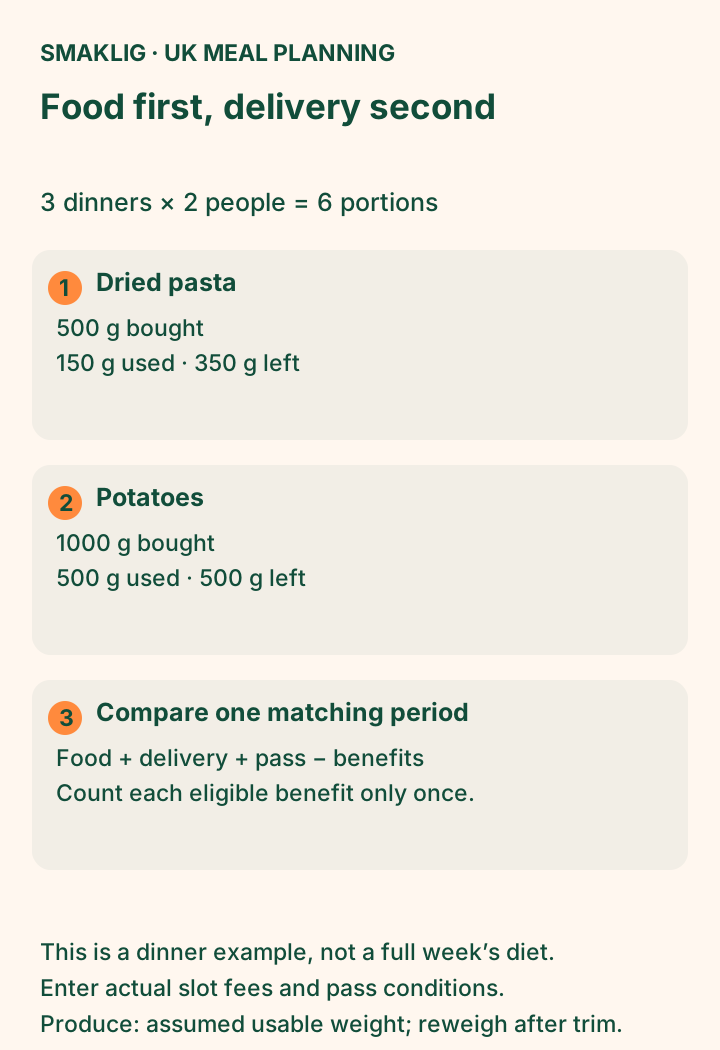
The ingredient example supplies three dinners; the delivery-cost worksheet applies to your complete order.
Cook the example dinners#
Dinner 1: turkey and tomato pasta#
For two portions, use 300 g turkey mince, 150 g dried pasta, 400 g chopped tomatoes, 100 g onion, 200 g carrots, 15 ml cooking oil, 2 g garlic granules and 2 g dried mixed herbs.
Finely chop the onion and grate the carrots. Soften both in the oil in a wide pan. Add the mince and break it apart while cooking, keeping raw-meat utensils separate from ready-to-eat food. Stir in the garlic, herbs and tomatoes. Simmer until the vegetables are tender and the mince is thoroughly cooked; add a little water if the sauce catches or thickens too much.
Cook the pasta according to its packet, drain and combine with the sauce. The FSA's cooking guidance gives 70°C for two minutes, or 75°C for 30 seconds, as suitable centre-temperature combinations. Use a clean thermometer to check the meat sauce where needed; colour or a timer alone is not proof. Divide into two portions.
Dinner 2: smoky chickpea and vegetable couscous#
For two portions, use 240 g drained cooked tinned chickpeas, 150 g dried couscous, 200 g pepper, 200 g carrots, 100 g onion, 15 ml cooking oil, 2 g garlic granules and 2 g smoked paprika.
Remove the pepper's core and seeds, checking you have the required usable weight. Chop the pepper and onion and cut the carrots into small pieces. Cook the vegetables in the oil, stirring regularly. Add a small splash of water and cover briefly if the carrots need help softening. Add the garlic, paprika and drained chickpeas; cook until the vegetables are tender and the chickpeas are piping hot.
Prepare the couscous with the amount of boiling water and standing time stated on its packet. Fluff and combine with the hot vegetables, then serve. Dried chickpeas are not a direct replacement for cooked tinned chickpeas in this method.
Dinner 3: potato, pea and egg skillet#
For two portions, use 500 g potatoes, 4 eggs, 200 g frozen peas, 100 g onion, 15 ml cooking oil and 2 g dried mixed herbs.
Cut the scrubbed potatoes into small cubes, boil until tender and drain. Cook the peas according to their packet. Soften the chopped onion in the oil in a large frying pan, then add the potatoes, peas and herbs. Beat the eggs, pour into the pan and stir gently over a moderate heat until fully set and the dish is hot throughout. Serve two portions immediately.
The plan uses wheat in conventional pasta and couscous, and eggs. Check every product's allergen and cross-contamination information; substitutions do not establish allergy suitability.
Compare delivery costs over one matching period#
Use the same food list, address, order dates and comparison period for both options. Check service availability for your postcode before calculating anything. This guide has not tested an address, account, slot, minimum spend or delivery fee.
| Worksheet input | Your own value | Include exactly this |
|---|---|---|
| Comparison period | Fill in start and end dates | A period matching the pass commitment you are considering |
| Planned orders | Fill in dates and number | Orders you realistically expect, including weeks away |
| Food and other goods, F | Fill in total £ | All packs actually bought across those orders |
| Individual delivery charges, D | Fill in total £ | The actual comparable slot charges without the pass |
| Pass payment, P | Fill in total £ | All pass payments owed for the comparison period |
| Remaining charges with pass, R | Fill in total £ | Charges the pass does not cover for those same orders |
| Verified other pass benefit, B | Fill in £ only if usable | An eligible benefit on purchases you would make anyway |
Compare without pass = F + D with with pass = F + P + R − B. Use B = £0 unless you have verified eligibility and can avoid double-counting a discount already deducted from F. If the two options require different spending on goods, calculate separate food totals rather than cancelling F out.
The pass improves this narrow cost comparison only when D exceeds P + R − B. If each eligible order would otherwise have the same fee, you can divide the pass cost by that fee as a first estimate, but differing slots or remaining charges require the actual totals above. No invented “average delivery fee” is used here.
An annual payment divided by 12 is an equivalent monthly amount, not proof that you can cancel after one month or pay only that fraction. Record the actual commitment, payment schedule and renewal conditions. Exclude imaginary extra orders made solely to make the division look favourable.
What Smart Pass covers needs a separate check#
Ocado's Smart Pass page, checked on 21 September 2026, distinguishes Anytime and Midweek plans; Midweek applies to Tuesday–Thursday. Check that your planned slots qualify. The page also sets out renewal conditions and separately charged deliveries during Christmas week, so a pass must not be described as removing every possible delivery charge.
Put any non-covered slot into R. A cheaper-looking plan is not useful if your household cannot receive deliveries on its eligible days. Check all current terms and order conditions before subscribing; no current pass price or guaranteed saving is claimed here.
Promotional codes and future rewards also need their own lines. Use only discounts valid for your account and actual order, and compare ordinary repeat spending separately from a one-off introductory offer. Buying additional unwanted goods to qualify changes F and can erase the apparent benefit.
M&S products at Ocado are a different checkout#
M&S's loyalty guidance says Sparks is not available on the Ocado website. Do not subtract an M&S wallet reward from this Ocado worksheet. Likewise, an M&S in-store offer is not evidence that the same bundle, price or eligibility applies at Ocado; check the actual Ocado listing and terms.
On arrival, check your delivered items and substitutions against the quantities, allergens and intended meals. A replacement pack can change both your checkout total and what remains after cooking. Update the ingredient rows rather than treating the original list as a receipt.
Follow use-by dates and storage labels. For suitable cooked leftovers, FSA guidance advises prompt cooling, refrigeration within two hours, then eating within 48 hours or freezing. Defrost in the fridge, use within 24 hours after fully defrosting and reheat only once until steaming hot. No spare cooked portions are assumed in this plan.
Start with the ingredient list, then add everything else your household needs before applying the worksheet. For seven separate dinner ideas, see the UK family meal plan.
How this guide was prepared#
Alexander Eriksson, founder of Smaklig, prepared this original planning example. It has not been kitchen-tested or priced as an Ocado basket. Official sources were checked on 21 September 2026; this is a fact-check date, not a publication date. Our method explains assumed quantities and source limitations.
Questions about this plan
Does Smart Pass remove every delivery charge?
No. Check the current plan and eligible days. Ocado distinguishes Anytime and Midweek plans, with Midweek applying Tuesday–Thursday, and says Christmas-week deliveries are charged separately.
When could a pass cost more than individual slots?
When its payment and remaining charges exceed the actual slot fees you would otherwise pay, after counting only verified usable benefits. Compare the same dates and realistic number of orders.
Can I use Sparks at Ocado?
M&S says Sparks is not available on the Ocado website. Do not deduct an M&S wallet reward from the cost of an Ocado order.
Are M&S in-store offers necessarily the same at Ocado?
No equivalence is assumed here. Check the actual Ocado product, pack, offer and terms rather than applying an M&S in-store bundle price to a different checkout.
Sources and further reading
- Smart Pass — Ocado
- Loyalty and rewards — Marks & Spencer
- How to chill, freeze and defrost food safely — Food Standards Agency
- Cooking your food — Food Standards Agency