

An Asda meal plan needs two cost totals: the money required at checkout and the value of the ingredients used in the dinners. A recipe can use a small share of a bottle or bag while your first shop still has to pay for the whole thing. This three-dinner plan makes that difference visible.
It serves four people at each dinner: 12 dinner portions, with no lunches, breakfasts, drinks or delivery charge included. The original recipes have not been kitchen-tested. All pack sizes below are planning assumptions, not verified Asda products. There are no observed prices in this guide; enter your own current shop and pack information.
AI-generated content. Always verify ingredients and allergen information yourself.
The Asda meal plan and its shared ingredients#
| Dinner | Main ingredients | Accounting job |
|---|---|---|
| 1 | Sausage and bean casserole with potatoes | Use the complete example sausage pack and both drained bean tins. |
| 2 | Broccoli and carrot peanut noodles | Show the small shares used from larger condiment and frozen packs. |
| 3 | Lentil and carrot soup with bread | Finish the planned carrots and freeze unused bread if its label permits. |
The carrots are deliberately split 300 g, 300 g and 400 g. The plan buys no second bag for the soup. Fresh sausages go first within their use-by date; an advertised offer is no reason to hold them for an unsafe later meal. Choose your actual cooking days around the labels.
Full packs first, recipe quantities second#
Check your cupboards before purchasing. All condiments are counted in the table, including oil: they are not free just because a recipe calls them staples. Water and optional salt and pepper are the only variable, uncosted exceptions.
Weights are raw, dry or frozen as stated. Nominal fresh-vegetable purchase weights assume the listed usable quantities; trim loss is unmeasured. Keep edible carrot and potato skins where suitable, remove inedible material, and weigh what remains. If preparation leaves less than required, top up the purchase or recalculate the recipe and cost rather than silently shrinking the portions.
| Ingredient | Example purchase | Used across three dinners | Ingredient remainder |
|---|---|---|---|
| Raw sausages | 1 × 400 g | 400 g | 0 g |
| Cooked tinned cannellini beans | 2 × 400 g tins (240 g drained each) | 480 g drained | 0 g beans; 320 g liquid discarded |
| Carrots | 1 × 1000 g | 1000 g | 0 g |
| Onions | 1 × 1000 g | 300 g | 700 g |
| Tinned chopped tomatoes | 2 × 400 g | 800 g | 0 g |
| Potatoes | 1 × 1000 g | 800 g | 200 g |
| Cooking oil | 1 × 500 ml | 45 ml | 455 ml |
| Smoked paprika | 1 × 40 g | 3 g | 37 g |
| Garlic granules | 1 × 40 g | 6 g | 34 g |
| Dried noodles | 1 × 500 g | 300 g | 200 g |
| Frozen broccoli | 1 × 1000 g | 400 g | 600 g |
| Peanut butter | 1 × 340 g | 60 g | 280 g |
| Soy sauce | 1 × 150 ml | 30 ml | 120 ml |
| Dried red lentils | 1 × 500 g | 240 g | 260 g |
| Sliced bread | 1 × 800 g | 400 g | 400 g |
| Ground cumin | 1 × 40 g | 4 g | 36 g |
The beans contribute 480 g drained food from an assumed 800 g net purchase; 320 g liquid is discarded. If your tins' drained yield differs, change the tin count or recipe. For costing, allocate the full price of the two tins to the beans used: the drained liquid is not a saleable remainder or a second portion.
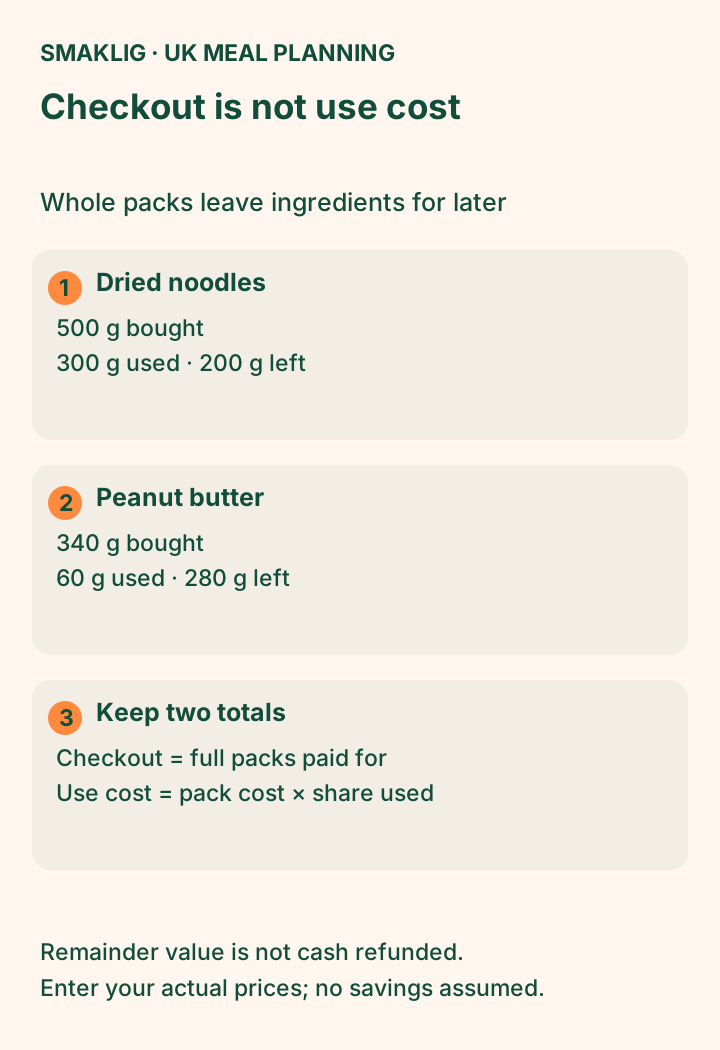
The two quantities illustrate pack accounting. They are not an Asda price comparison.
Your own-input checkout and consumed-cost worksheet#
For each ingredient, write P = the price you actually pay per pack. If identical packs have different offer prices, use their combined checkout cost rather than multiplying by an inapplicable single-pack offer. Copy the product, weight, date, shop or online channel, and any membership condition next to the entry.
| Example row | Checkout cost to enter | Cost allocated to these dinners | Value still in unused food |
|---|---|---|---|
| Noodles, one 500 g pack | Your noodle pack price P | P × 300 ÷ 500 | P × 200 ÷ 500 |
| Peanut butter, one 340 g jar | Your peanut butter price P | P × 60 ÷ 340 | P × 280 ÷ 340 |
| Carrots, one 1000 g bag | Your carrot bag price P | P, if the full usable amount is eaten | Zero in the no-trim arithmetic example |
| Beans, two tins used in full after draining | Your total price for both tins B | B | Zero beans left; liquid is discarded |
Apply the same method to every row. Checkout total = the sum of the whole packs you need to buy. Consumed ingredient cost = the sum allocated to the planned food. Divide consumed ingredient cost by 12 only if you want the average across these twelve dinner portions. Individual dinners have different costs. Neither number is a measured cost until you add actual prices.
Remainder value is an accounting allocation, not money returned to your account. If food is discarded, record waste separately rather than calling it future savings. When using something already in the cupboard, it adds no new checkout payment, but its consumed cost is not automatically zero; use its known purchase cost or mark that input unknown. Keep missing values blank, not zero.
Add delivery, bags and any other actual charges on separate lines. Exclude future rewards from today's payment unless an eligible voucher really reduces that transaction. Asda's Rewards terms distinguish earning Cashpot under applicable Mission conditions from converting it into a voucher and redeeming that voucher under its conditions. Do not subtract an unredeemed reward twice or assume every purchase earns one.
Three original dinners#
Dinner 1: sausage and bean casserole with potatoes#
For four portions, use 400 g raw sausages, 480 g drained cooked cannellini beans, 300 g carrots, 150 g prepared onion, 400 g chopped tomatoes including juice, 800 g potatoes, 15 ml oil, 3 g smoked paprika and 2 g garlic granules.
Prepare and cook the sausages according to their packet. Meanwhile, chop the onion and carrots and soften them in the oil in a wide saucepan. Add the garlic, paprika and tomatoes with a little water. Simmer until the carrots are tender, stirring to prevent sticking. Add the drained beans and heat thoroughly. Combine with the cooked sausages, cutting them into suitable serving pieces with clean utensils.
Scrub the potatoes, cut into even chunks and boil until tender. Drain and divide with the casserole into four portions. Use the FSA's cooking guidance to check the sausages: a clean thermometer at the centre can confirm an appropriate time and temperature, such as 70°C for two minutes or 75°C for 30 seconds. Colour or browned skin alone is not proof.
Dinner 2: broccoli and carrot peanut noodles#
For four portions, use 300 g dried noodles, 400 g frozen broccoli, 300 g carrots, 60 g peanut butter, 30 ml soy sauce, 15 ml oil and 2 g garlic granules.
Cut the carrots into thin batons. Cook the broccoli according to its packet until thoroughly hot and tender enough for your household. Stir the peanut butter and soy sauce with a little warm water to make a pourable sauce. Cook the noodles according to their packet and drain.
Soften the carrots in the oil in a large pan, adding a splash of water if needed. Add the garlic, cooked broccoli, noodles and sauce. Toss over the heat until everything is hot, adding water gradually to loosen the sauce. Divide into four portions. Check the labels for allergens across the noodles, peanut butter and soy sauce; this recipe is not an allergy-filtered recommendation. A substitute needs its own label, quantity and cost check.
Dinner 3: lentil and carrot soup with bread#
For four portions, use 240 g dried red lentils, 400 g carrots, 150 g prepared onion, 400 g chopped tomatoes including juice, 400 g sliced bread, 15 ml oil, 4 g ground cumin and 2 g garlic granules.
Finely chop the onion and carrots. Soften in the oil, stir in the cumin and garlic, then add the tomatoes, lentils and about 1.2 litres of water. Follow the lentil packet's cooking instructions and simmer until both lentils and carrots are soft, stirring and adding more water as necessary. Mash lightly for a thicker texture or leave chunky. Divide the soup and bread into four portions. Water changes the texture, not the amount of lentils allocated to each person.
Own-brand swaps that preserve the dinner#
Compare the same cooking role before comparing price. Raw sausages and a ready-cooked sausage product may need different preparation; dry noodles and ready-to-wok noodles are not the same weight basis. For beans, use drained yield, not the larger net tin weight. For frozen broccoli, check whether extra sauce or seasoning changes the product you intended to buy.
Then compare pack price, price per common unit, usable amount, ingredients and storage instructions. The CMA's unit-pricing guide supports comparing like units; it does not establish that every own-brand item is cheaper or that this whole Asda shop beats another retailer. Your household's actual list is the relevant comparison.
Give each remainder a next job#
Keep the 600 g frozen broccoli frozen and leave the unused dried goods sealed. The 400 g unused bread can be portioned and frozen promptly if its packaging permits, rather than waiting until it is stale. Follow labels for opened sauces, peanut butter and fresh onions; a ledger balance is not a storage-life guarantee.
For cooked leftovers, FSA guidance is to cool and refrigerate within two hours, use within 48 hours or freeze promptly, and reheat only once until steaming hot throughout. Label frozen portions so you know what they contain. Do not count a portion as both tonight's dinner and tomorrow's lunch.
If your next shop depends on seasonal vegetables, the Aldi Super 6 planning guide shows how to adapt meals to the current selection without assuming a fixed price or range. If you want to turn one shop into labelled freezer dinners instead, use the Morrisons batch-cooking guide for its separate portion and storage timetable.
For a longer starting list, see the seven-dinner UK family plan. Read our editorial method for how examples differ from observed baskets and the author page for byline information. Bring your completed worksheet back to the next shop: the useful result is knowing what you must pay and what food you already own.
Questions about this plan
Why is my shop more expensive than the recipe portion totals?
Portion costs can allocate only the fraction of oil, noodles or seasoning used. Checkout charges for the whole packs you need to buy. Keep those totals separate and include condiments and any delivery charges rather than treating them as free.
Do own-brand products always cost less?
Do not assume so. Compare your current eligible price, the same unit, usable quantity and a product that performs the same cooking job. Offers, pack sizes and what your household will actually eat can change the result.
How are leftovers counted in this plan?
The table shows unused ingredients after twelve planned dinner portions, not extra cooked lunches. Allocate their value separately. Drained bean liquid is discarded liquid, not leftover beans; food later thrown away should be recorded as waste.
Does a comparison basket prove my Asda shop is cheapest?
No. A basket comparison applies to its own products, quantities, date and conditions. This guide contains no observed product prices and makes no cheapest-shop claim. Fill the worksheet with your actual eligible packs and charges.
Sources and further reading
- A short guide to unit pricing — Competition and Markets Authority
- Asda Rewards terms and conditions — Asda
- How to chill, freeze and defrost food safely — Food Standards Agency
- Cooking your food — Food Standards Agency