

A Lidl meal plan should work before you earn a point. Start with the food your household will eat, then sort offers into three groups: an item already needed, a useful replacement or an unnecessary extra. These three dinners and the quantity list make that decision visible without inventing a personalised reward.
These are original planning ideas, not kitchen-tested recipes. The example makes three dinners for four people: 12 dinner portions, not a whole week’s food or a set of extra lunches. Pack sizes are assumptions, not verified products or prices at this retailer. Adjust appetites and check the actual packs before shopping.
AI-generated content. Always verify ingredients and allergen information yourself.
Check today’s programme, not an old threshold guide#
Lidl GB’s current Points page says Coupon Plus ended on 5 May 2026 and was replaced by Points. It also tells shoppers to activate reward coupons before scanning. Check your actual coupon’s dates, eligible products and conditions rather than assuming an old monthly spending rule still applies.
Northern Ireland has its own Lidl Plus page, which also advertises Points. This does not prove identical earning or redemption rules. Use the local programme and terms for the shop you visit. Neither an app screenshot from another shopper nor a GB guide establishes your personal NI reward.
This meal plan includes no points balance, earned cash value or assumed coupon. The source check tells you how to approach the programme; it is not a test of an individual account.
Put each offer through the dinner test#
| Decision | Example from the plan | What to check | Action |
|---|---|---|---|
| Already needed | A pack that supplies the 300 g peas for the hash | Exact product, usable pack amount and applicable price | Buy the suitable quantity, then use any valid offer |
| Useful replacement | Frozen broccoli instead of the peas | Cooking method, quantity, allergens and its own price | Rewrite the list and cook the replacement correctly |
| Unnecessary extra | Another pack added only to chase a reward | Extra checkout spend and a genuine future use | Leave it out unless both the budget and storage plan support it |
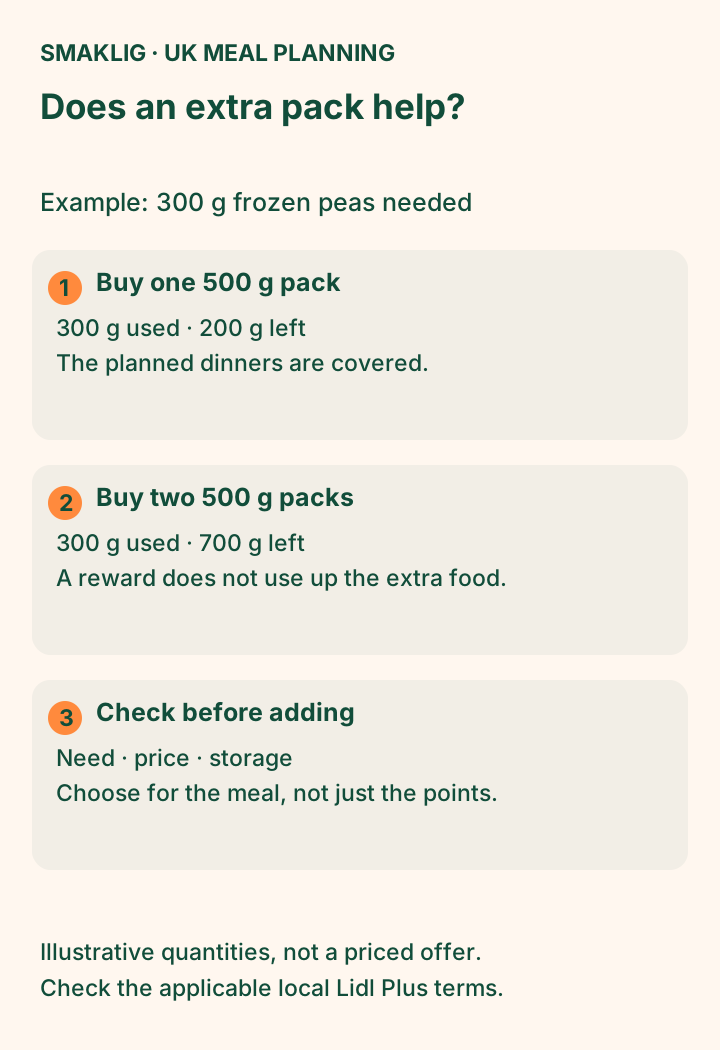
These are decision examples, not live offers. The baseline pea purchase is 500 g and the dinner uses 300 g, leaving 200 g frozen. Buying a second 500 g pack would leave 700 g after the same dinner. That is more food bought, not evidence of a saving or three extra meals.
The CMA’s unit-pricing guide can help compare similar packs. Still write down the whole payment required. If you change to broccoli, do not simply transfer the pea coupon or assume identical cooking times. Follow the new label and account for the amount you will use.
Keep a separate note for rewards you may use later. A possible future benefit should not be subtracted from the money required at today’s checkout unless a valid discount is actually applied to that transaction.
One shopping list#
The amounts below cover all three dinners. Weigh pasta, rice and lentils dry; tinned pulses are weighed drained. Vegetable weights are before cooking, with trimming or peeling losses not measured. Buy a little more where your preparation needs it, and record that adjustment. Water and optional salt or pepper are not fixed quantities.
Oil and seasonings are included as example full purchases. Cross them off only if you already have enough suitable ingredients; cupboard food is not automatically free. The remainder column is food left from a purchase, not an additional meal already made.
| Ingredient | Assumed amount bought | Used in this plan | Remaining ingredient |
|---|---|---|---|
| Cooked tinned kidney beans | 2 tin(s): 800 g total net, 480 g drained | 480 g | 0 g edible; 320 g liquid drained away |
| Tinned chopped tomatoes with juice | 2 × 400 g | 800 g | 0 g |
| Onions | 1 × 500 g | 500 g | 0 g |
| Carrots | 1 × 500 g | 300 g | 200 g |
| Dried rice | 1 × 500 g | 300 g | 200 g |
| Potatoes | 1 × 1000 g | 800 g | 200 g |
| Eggs | 1 × 12 each | 8 each | 4 each |
| Frozen peas | 1 × 500 g | 300 g | 200 g |
| Dried pasta | 1 × 500 g | 300 g | 200 g |
| Cooked tinned chickpeas | 2 tin(s): 800 g total net, 480 g drained | 480 g | 0 g edible; 320 g liquid drained away |
| Frozen spinach | 1 × 500 g | 300 g | 200 g |
| Cooking oil | 1 × 500 ml | 45 ml | 455 ml |
| Smoked paprika | 1 × 40 g | 4 g | 36 g |
| Ground cumin | 1 × 40 g | 4 g | 36 g |
| Dried mixed herbs | 1 × 15 g | 4 g | 11 g |
Planning quantities, not a priced retailer basket. The diagram summarises the list; it is not evidence of a tested recipe or a saving.
Three dinners from the list#
Smoky kidney bean and carrot chilli#
For 4 portions: 480 g cooked tinned kidney beans, 400 g tinned chopped tomatoes with juice, 150 g onions, 300 g carrots, 300 g dried rice, 15 ml cooking oil, 4 g smoked paprika, 4 g ground cumin.
Soften the chopped onion and finely chopped carrot in the oil. Add the paprika and cumin, stir briefly, then add the tomatoes and drained cooked kidney beans. Simmer until the carrot is tender and the sauce thoroughly hot, adding a little water if it becomes dry. Cook the rice fresh following its packet and divide between four portions with the chilli. Use cooked tinned beans, not dried kidney beans tipped into the pan.
Potato, pea and egg hash#
For 4 portions: 800 g potatoes, 8 each eggs, 300 g frozen peas, 150 g onions, 15 ml cooking oil.
Cut the potatoes into small cubes, boil until just tender and drain. Soften the chopped onion in the oil, add the potatoes and cook until hot, turning gently. Cook the peas according to their packet, then stir them in. Beat the eggs, pour them through the mixture and cook, turning in sections, until fully set. The result is a soft hash, not a claim of a crisp restaurant-style finish. Serve four portions while hot.
Chickpea and spinach pasta#
For 4 portions: 300 g dried pasta, 480 g cooked tinned chickpeas, 300 g frozen spinach, 400 g tinned chopped tomatoes with juice, 200 g onions, 15 ml cooking oil, 4 g dried mixed herbs.
Soften the chopped onion in the oil, add the tomatoes and herbs, and simmer until tender. Stir in the chickpeas and frozen spinach, following the spinach packet’s cooking instructions and heating the sauce thoroughly. Cook and drain the pasta separately as directed, then combine. Add a little water to loosen if necessary. Drain the tinned chickpeas before measuring the required amount.
Three evenings, not a week of fridge leftovers#
Use the three recipes across three evenings, choosing actual use-by dates that fit. Keep the frozen peas and spinach frozen until measured out. Follow the egg carton’s storage instructions. Dry pasta or rice left in a packet is not the same thing as a cooked portion waiting in the fridge.
For suitable cooked leftovers, follow FSA advice: cool promptly, refrigerate within two hours and eat within 48 hours or freeze. Follow shorter packaging instructions, defrost in the fridge and use within 24 hours once fully thawed. Reheat only once until steaming hot throughout.
For rice, use the Food Standards Scotland guidance: cool quickly, ideally within an hour, refrigerate and use within 24 hours. Cooking the chilli’s rice fresh is the simplest approach in this example. A points offer does not change any food’s safe storage period.
The hash contains eggs; conventional pasta contains wheat. Read labels on spices, tins and substitutes too. This is a general planning example with no personal allergy assessment.
Before you shop#
Check dates, labels, quantities and your actual household’s needs. Tick off what is safely available at home, then enter the packs you need to buy. A substitution changes the ingredient list, the method and sometimes the allergens; it does not preserve an old price or make a meal allergy-safe.
For a longer plan, use our seven-dinner UK family meal plan. Read our method for assumptions and corrections, or browse the available guides.
This guide is by Alexander Eriksson, founder of Smaklig. Retailer and food-safety sources were checked on 21 September 2026; that is a source-check date, not a claimed publication or kitchen-test date.
Questions about this plan
What happened to Lidl Coupon Plus?
Lidl GB says Coupon Plus ended on 5 May 2026 and was replaced by Lidl Points. Use the current programme information, not an old spending-threshold guide. Exact earn, expiry and redemption conditions should be checked for the reward and shopping channel you use.
Do I need to activate a reward coupon?
Lidl GB’s current Points guidance says reward coupons need activating before scanning. Check the coupon in your app, including expiry and eligible product. This guide has not observed a personal account or included a hypothetical coupon in the cost of its meal plan.
Does the same Lidl Plus programme apply in Northern Ireland?
Lidl Northern Ireland also advertises Points and offers, but it has its own local programme page. Do not copy GB earning, reward or expiry conditions into an NI shop. Check the relevant local terms and the actual coupon before buying.
Is buying extra to earn points worthwhile?
Check the extra cash you would spend and whether the food has a real use. Points or a future reward are not automatically a reduction in this transaction’s payment. If a purchase exists only to chase a reward, leave it out until you have compared the whole cost and conditions.
Sources and further reading
- Lidl Plus Points — Lidl GB
- Lidl Plus in Northern Ireland — Lidl Northern Ireland
- A short guide to unit pricing — Competition and Markets Authority
- How to chill, freeze and defrost food safely — Food Standards Agency
- Food storage — Food Standards Scotland